Une interview sous-titrée d'Elinor Ostrom, prix Nobel d'économie 2009, sur les institutions.
Mostrar mensagens com a etiqueta SOCIO-ECOLOGICAL SYSTEMS. Mostrar todas as mensagens
Mostrar mensagens com a etiqueta SOCIO-ECOLOGICAL SYSTEMS. Mostrar todas as mensagens
sexta-feira, 28 de maio de 2010
Resilient social-ecological systems: How? Institutional diversity
stockholmresilience
Professor Elinor Ostrom: "Resilient Social-Ecological Systems: How Do We Achieve Them?"
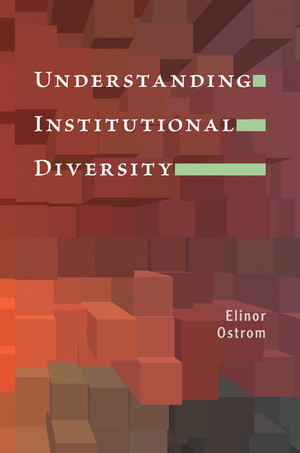
Winner of the 2006 William H. Riker Book Award, Political Economy Section, American Political Science Association
Elinor Ostrom, winner of the 2005 James Madison Award, American Political Science Association
The analysis of how institutions are formed, how they operate and change, and how they influence behavior in society has become a major subject of inquiry in politics, sociology, and economics. A leader in applying game theory to the understanding of institutional analysis, Elinor Ostrom provides in this book a coherent method for undertaking the analysis of diverse economic, political, and social institutions.
Understanding Institutional Diversity explains the Institutional Analysis and Development (IAD) framework, which enables a scholar to choose the most relevant level of interaction for a particular question. This framework examines the arena within which interactions occur, the rules employed by participants to order relationships, the attributes of a biophysical world that structures and is structured by interactions, and the attributes of a community in which a particular arena is placed.
The book explains and illustrates how to use the IAD in the context of both field and experimental studies. Concentrating primarily on the rules aspect of the IAD framework, it provides empirical evidence about the diversity of rules, the calculation process used by participants in changing rules, and the design principles that characterize robust, self-organized resource governance institutions.
Review:
"Understanding Institutional Diversity is a comprehensive book on the management of the common pool. It includes overviews of major theoretical issues and empirical studies. Anyone who is interested in how common-pool problems are or are not successfully resolved by locally devised arrangement should read it."--Gary D. Libecap, The Independent Review
Endorsements:
"This will undoubtedly be a very popular, much-assigned, and much-cited magnum opus."--Carl Simon, University of Michigan
"What emerges from Elinor Ostrom's book is precisely what the title suggests---an understanding of the diverse nature of institutions that exist in human societies to promote human cooperation or to hinder it. This is a significant work by one of the most thoughtful social scientists in the world and it will attract a large number of readers and enlighten them."--Peter Boettke, George Mason University
Table of Contents
Another Princeton book by Elinor Ostrom:


quinta-feira, 27 de maio de 2010
The Journey - Ecolonie from The Journey TV on Vimeo.
Ecolonie has just celebrated its 20th birthday. This ecological community is located in the North of France, in the last 10 years the community have developed their self -sustainability, spreading the community out 40 hectares of land, and usefully incorporating goat farming and cheese production into their vision. The philosophy of the community is grounded in the belief of living in harmony with nature, and aims to be a European centre where different cultures meet in a friendly, open atmosphere.
ecolonie.org
This short film is part of "The Journey" an unique documentary project that delves into environmental, socio-culture and economic issues, with a questioning mind.
The focus of the project is to find and film inspiring ideas and projects over a wide spectrum of individuals and cultures, whilst examining our ability to reform our ideals, and our lifestyle in order to make positive changes for our planet and the human race.
The “Journeymen” (a person whom travels in order to gain experience, skills and knowledge) go in search of these stories – equipped only with minimal filming gear and personal possessions, they document their experience as they travel to global communities to observe, question and learn.
It is an organic process that grows, evolves and takes it’s own direction. With no planned route nor destination, the journeymen believe they will connect with the right people and places at the right time to film, aid and guide them on.
The project is currently filming and traveling through the UK. As the project travels short films are uploaded that can be viewed on this website. It is the long-term goal that this project will travel internationally to create a feature length film that will be released, to be viewed for free.
The projects aims to benefit individuals, projects and communities by sharing knowledge, offering solutions and connecting people through film.
It is the hope this project will touch and inspire people, by conveying the beauty within human nature and our world and resonating what is actually possible, when it comes it comes to our ability to change the world for the better.
know of an inspiring story? want to get involved?
info@the-journey.tv
follow “the journey” on facebook
facebook.com/pages/The-Journey/81206620786
the-journey.tv
segunda-feira, 12 de abril de 2010
Economia vs Ecologia
Así como el pez no sabe lo que es el agua, Ignoramos que en acumular desperdiciamos la unica oportunidad de disfrutar... Esta nuestra única vida
sexta-feira, 15 de janeiro de 2010
The Dominant Animal by Paul R. Ehrlich and Anne H. Ehrlich
Over millions of years and through countless genetic twists and turns, humanity has evolved into the dominant animal. We have populated the globe, reshaped most landscapes, eradicated myriad populations and species of other organisms, and transformed the land surface, oceans, and climate. The vast environmental changes we have produced and the intricate cultures we have created are now shaping evolution. From the complex workings of our genes to what we eat and how we govern ourselves, we are changing our world and our world is changing us. We are creating our future. But what kind of future will it be? Today, we face the task of learning to manage the planet so that humanity can successfully transition to a sustainable future—or we will face increasingly harsh consequences.Quite an assignment, to give the necessary background for that in a single course, but by focusing on essential processes it can be done—enabling students to learn a body of scientifically grounded information that is both essential and too seldom presented at a level accessible to introductory as well as more advanced students. We believe that such basic scientific background is critical to understanding the most important processes of life and to functioning as a responsible citizen. In years to come, citizens will be called upon to consider and make decisions on topics as diverse as climate change, public health, racial and ethnic discrimination, biodiversity preservation, and building a well-governed, equitable, and sustainable society.
Homo sapiens is suffering today from a vast "culture gap." Our distant ancestors living in hunter-gatherer groups all possessed virtually the same non-genetic information in their culture. The exceptions were few—perhaps a man had a secret technique for making sharp spear points, or a woman knew a certain plant had special medicinal properties. But all that began to change when the agricultural revolution allowed increasing specialization of tasks, and in part as a result, the culture gap has grown exponentially in the past couple of centuries. Even the most educated American can't possibly store more than a minute fraction of Western culture. Given, for example, the parts of a TV set, how many of us could assemble a working set, to say nothing of describing the processes used to manufacture the parts, the sources of the materials used, or the methods by which those materials were gathered and processed?
Obviously, no one can be the repository of all of today's culture, but there clearly is a need to close critical parts of the culture gap so that we can share some basic understandings about the world. If humanity is to attain a happy and sustainable society, common science-based perceptions of the human predicament and how it can be resolved will be essential. And that means knowing how the dominant animal achieved dominance, and what that dominance portends for the future. That's where this book comes in. The Dominant Animal was designed as a teaching tool, based on a course Paul Ehrlich gives called Human Evolution and Environment. This Web site was designed to aid those who teach students in formal classes and to help enrich the experience of those students. It is divided into an open part, accessible to all, and a closed part, addressed to teachers.
dominantanimal.org
"Wisdom seminar" with Paul R. Ehrlich

Professor Ehrlich held this seminar 11 September 2007 in Stockholm where he focused his talk on coevolution, population growth and the perspective of ecosystem services.
About Paul Ehrlich
Paul R. Ehrlich has pursued long-term studies of the structure, dynamics, and genetics of natural butterfly populations. He has also been a pioneer in alerting the public to the problems of overpopulation, and in raising issues of population, resources, and the environment as matters of public policy.
A central focus of his group is investigating ways that human-disturbed landscapes can be made more hospitable to biodiversity. The Ehrlich group's policy research on the population-resource-environment crisis takes a broad overview of the world situation, but also works intensively in such areas of immediate legislative interests as endangered species and the preservation of genetic resources.
Professor Ehrlich is a fellow of the American Association for the Advancement of Science, the American Academy of Arts and Sciences, and the American Philosophical Society, and a member of the National Academy of Sciences.
Professor Ehrlich has received several honorary degrees, e.g. the John Muir Award of the Sierra Club, a MacArthur Prize Fellowship, the Crafoord Prize of the Royal Swedish Academy of Sciences, the Volvo Environmental Prize, the United Nations' Sasakawa Environment Prize, the Blue Planet Prize, and the Eminent Ecologist Award of the Ecological Society of America.
Latest videos - Stockholm Resilience Centre
quinta-feira, 14 de janeiro de 2010
Collective Action and the Commons: What Have We Learned?
Elinor Ostrom, a political scientist from Indiana University and winner of the 2009 Nobel Memorial Prize in Economic Sciences, looks at a variety of research into why some groups self-organize and others do not, and the relevance of the theory of collective action to the governance and management of natural resources.
Ostrom is considered one of the leading scholars of common pool resources--forests, fisheries, oil fields, grazing lands, and irrigation systems. In particular, her work emphasizes how humans interact with ecosystems to maintain long-term sustainable resource yields.
Ostrom spoke at Cornell on September 17, 2009.
sábado, 26 de dezembro de 2009

Professor Elinor Ostrom held on 29 May 2007 the seminar "Resilient Social-Ecological Systems: How Do We Achieve Them?"
Given rapid changes in large-scale human and biophysical processes — carbon emissions, population increase and migrations, over-harvesting and pollution leading to loss of species — many scientists are worried that many of the social-ecological systems existing today may collapse by the end of the 21st century. Is this an exaggerated worry?
The thesis Ostrom will present is that the negative prognosis will indeed occur in many parts of the world if we do not worry a great deal about these processes and their consequences.
More important than simply worrying, however, is the development of a strong diagnostic method for analyzing the diversity of processes and the multiplicity of potential social and bio-physical solutions that are needed to cope effectively with these varied processes.
Past efforts to impose simple solutions to these complex problems have frequently led to worse outcomes than the problems addressed. Our need today is building a strong inter-disciplinary science of complex, multi-level systems that will enable over-time a matching of potential solutions to a careful diagnosis of specifi c problems embedded in a social-ecological context.
Ostrom will take some small steps toward this goal in her presentation.
She is a member of the American Academy of Arts and Sciences, the National Academy of Sciences, and the American Philosophical Society, and a recipient of a number of prestigious awards.
Her books include Governing the Commons (1990); Rules, Games, and Common-Pool Resources (1994); The Commons in the New Millennium: Challenges and Adaptations (2003); The Samaritan´s Dilemma: The Political Economy of Development Aid (2005); Understanding Institutional Diversity (2005); and Understanding Knowledge as a Commons: From Theory to Practice (2007).
More important than simply worrying, however, is the development of a strong diagnostic method for analyzing the diversity of processes and the multiplicity of potential social and bio-physical solutions that are needed to cope effectively with these varied processes.
Past efforts to impose simple solutions to these complex problems have frequently led to worse outcomes than the problems addressed. Our need today is building a strong inter-disciplinary science of complex, multi-level systems that will enable over-time a matching of potential solutions to a careful diagnosis of specifi c problems embedded in a social-ecological context.
Ostrom will take some small steps toward this goal in her presentation.
About Elinor Ostrom
Elinor Ostrom is Arthur F. Bentley Professor of Political Science; Co-Director of the Workshop in Political Theory and Policy Analysis, Indiana University, Bloomington; and Founding Director, Center for the Study of Institutional Diversity, Arizona State University.She is a member of the American Academy of Arts and Sciences, the National Academy of Sciences, and the American Philosophical Society, and a recipient of a number of prestigious awards.
Her books include Governing the Commons (1990); Rules, Games, and Common-Pool Resources (1994); The Commons in the New Millennium: Challenges and Adaptations (2003); The Samaritan´s Dilemma: The Political Economy of Development Aid (2005); Understanding Institutional Diversity (2005); and Understanding Knowledge as a Commons: From Theory to Practice (2007).
Subscrever:
Mensagens (Atom)