sábado, 20 de novembro de 2010

On Bullshit


PUPress

A conversation with Harry G. Frankfurt, author of On Bullshit, published by Princeton University Press
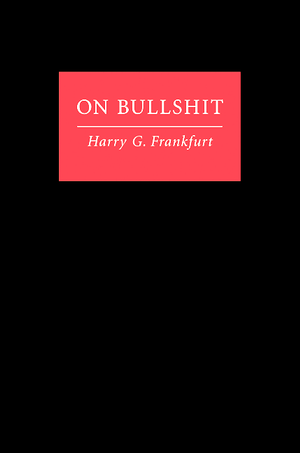
One of the most salient features of our culture is that there is so much bullshit. Everyone knows this. Each of us contributes his share. But we tend to take the situation for granted. Most people are rather confident of their ability to recognize bullshit and to avoid being taken in by it. So the phenomenon has not aroused much deliberate concern. We have no clear understanding of what bullshit is, why there is so much of it, or what functions it serves. And we lack a conscientiously developed appreciation of what it means to us. In other words, as Harry Frankfurt writes, "we have no theory."

Frankfurt, one of the world's most influential moral philosophers, attempts to build such a theory here. With his characteristic combination of philosophical acuity, psychological insight, and wry humor, Frankfurt proceeds by exploring how bullshit and the related concept of humbug are distinct from lying. He argues that bullshitters misrepresent themselves to their audience not as liars do, that is, by deliberately making false claims about what is true. In fact, bullshit need not be untrue at all.

Rather, bullshitters seek to convey a certain impression of themselves without being concerned about whether anything at all is true. They quietly change the rules governing their end of the conversation so that claims about truth and falsity are irrelevant. Frankfurt concludes that although bullshit can take many innocent forms, excessive indulgence in it can eventually undermine the practitioner's capacity to tell the truth in a way that lying does not. Liars at least acknowledge that it matters what is true. By virtue of this, Frankfurt writes, bullshit is a greater enemy of the truth than lies are.

Decrecimiento - Carlos Taibo


Decrecimiento - Carlos Taibo from ATTAC.TV on Vimeo.

En esta entrevista Carlos Taibo nos explica qué es el decrecimiento, nacido como crítica al crecimiento ilimitado en un mundo con recursos limitados, y como propuesta de debate social.

El decrecimiento es una corriente de pensamiento político, económico y social favorable a la disminución controlada de la producción económica con el objetivo de establecer una nueva relación de equilibrio entre el ser humano y la naturaleza, pero también entre los propios seres humanos.

Carlos Taibo es profesor titular de Ciencia Política y de la Administración en la Universidad Autónoma de Madrid.
Fuente: http://www.attac.tv/altermedia/2010/11/796

Carlos Taibo: en defensa del decrecimiento


Carlos Taibo: en defensa del decrecimiento (1ª parte) from Andrés Villanueva Parra on Vimeo.


Carlos Taibo: En defensa del decrecimiento (2ª Final) from Andrés Villanueva Parra on Vimeo.

Conferencia de Carlos Taibo, escritor, editor y profesor Titular de Ciencia Política y de la Administración en la Universidad Autónoma de Madrid. En ella expone el concepto de "decrecimiento" y sus consecuencias.
La conferencia tuvo lugar en el Ateneo de Badajoz, el jueves 13 de mayo del 2010.

sexta-feira, 19 de novembro de 2010

Conférence sur la Décroissance, Barcelone 2010


Conférence sur la Décroissance, Barcelone 2010

Carregado por lachainech

"Celui qui 
croit que la croissance peut être infinie dans un monde fini est soit un fou, soit un économiste."
Kenneth Boulding (1910-1993), président de l’American Economic Association.

L’association "Recherche & Décroissance" (www.degrowth.net) met en œuvre et diffuse des études et des recherches théoriques et pratiques s’inscrivant dans le champ de la décroissance économique. R & D soutient une décroissance économique en tant que réduction collective des capacités d’appropriation et d’exploitation des ressources naturelles ayant pour objectif une société plus écologique, plus équitable, plus démocratique et répondant aux besoins humains.

En marge de la deuxième Conférence sur la Décroissance, organisée par R & D , au mois de mars 2010 à Barcelone, nous avons pu recueillir les impressions de quelques intervenant-e-s et participant-e-s. Ils nous livrent leurs analyses à chaud de la situation du mouvement de la décroissance et leurs réflexions sur les changements nécessaires pour sauver notre monde de la catastrophe.

Cette seconde conférence, s’appuyant sur le succès de la première et l’élan de chercheurs travaillant sur la décroissance, entendait se concentrer sur les nouvelles conditions amenées par la crise économique et souhaitait développer des propositions politiques claires et des stratégies d’action dans le cadre de la décroissance.

Musique : "Puerquerama" de Toluca (Etat de Mexico), "I wanna be a white trash man" "Pare de sufrir" "Cinismo al servico de la masas" - myspace.com/pqrm

Entretiens réalisés par Fabienne Gautier - Fondation pour une Terre Humaine - www.terrehumaine.org

Réalisation Stéphane Pecorini - www.lachaine.ch

Décroissance


Reportage sur la journée de réflexion sur l'objection de croissance organisée à l'ULB en février 2009.
Interviews de Serge Latouche, Daniel Cauchy, Bernard Legros, Christian Arnsperger
http://video.google.com/videoplay?docid=-391255870606078479

Décroisance avec Pierre Lehmann


Décroissance 1/2 Pierre Lehmann


Décroisance 2/2 Pierre Lehmann Carregado por nature-boy-79

Ecologie écolo décroissance vert habitat logement vert yourte bio habitat biologique bio environnement bâtiment énergie fossile pétrole gaspillage poubelles poison toxique chalet maison building montagne espace nature respect terre villa paysans simpliste simple vie primaire aventure pavillon tente paille brique bois exotique isolation boue carton nature construction herbe fleures arbres arbrisseau altermondialiste anticapitaliste libertaire communisme économie partie déforestation énergie pétrole mode- de vie société égoïsme philosophie consommation poubelle matérialisme religion bouddha jésus jainisme saint Tibet mouton vegan veganisme végétarien végétalien légume tomate patate pomme de terre fruit corps étude primate biologie ethnologue sante neige eau couleur charpente menuiserie freegan freeganisme soleil apocalypse fin du monde enfant homme guerre politique lobby supermarché industrie argent fric travaille pauvre précaire désobéissance civile mer océans viande OGM toxique sauvage soja maïs colza bétail élevage gavage Environnement OGM- Soja, progrès écologie déforestation Amazonie désert manque Amérique du sud Europe Amérique Asie oiseau cheval fossile atlantique baleines paradis dalai lama Nicolas Hulot Greenpeace paix amour guerre nucléaire surexploitation exploitation esclave riche mondialisation entreprises profit intérêt bourse spéculation famine soja riz inde Russie socialisme communisme extrémisme délocaliser usine ouvriers précaire salaire RMI sécurité sociale chômage dette suicide mort France UMP

FIXING THE FUTURE


Watch the full episode. See more NOW on PBS.
In a one-hour PBS special airing Fixing the Future, Host David Brancaccio visits communities across America using innovative approaches to create jobs and build prosperity in our new economy.